

Dental ads ROI shows whether your advertising spend is generating enough patient revenue to justify the cost. This page helps dental practices connect ad spend, leads, booked patients and collected revenue so you can see where performance is breaking down across your dental PPC campaigns.
But when you look at the schedule, you are not seeing enough new patients in the chairs.
That is where the real question starts. Are your ads failing, or are potential patients disappearing somewhere between the click, the phone call, the booking and the appointment?
This analysis helps you trace that gap and separate an ad problem from a lead-handling, booking, or patient-conversion problem.
If your report stops at clicks and leads, you still do not know whether your dental ads are actually making money.
Know What Matters
Before you judge a campaign, separate two numbers that marketers often use interchangeably: ROAS and ROI. They answer different questions.
Return on ad spend tells you how much attributed revenue came back for the advertising dollars you spent.
Return on investment asks the broader business question. It considers the return after the costs you choose to include.
Follow The Patient
A click does not become revenue automatically. Your practice still has to turn that person's interest into an inquiry, appointment, completed visit and paying patient.
What this shows: Your advertising creates the opportunity. Your patient journey determines how much of that opportunity reaches the practice.
Follow Every Patient
| Patient Stage | What To Measure | What To Ask |
|---|---|---|
| Ad Click | Cost per click | Are we attracting relevant people? |
| Lead | Cost per lead | Are these realistic patient inquiries? |
| Booking | Cost per booking | Are inquiries scheduling appointments? |
| Show | Cost per attended appointment | Are booked patients arriving? |
| New Patient | Patient acquisition cost | What did one acquired patient cost? |
| Revenue | Collected revenue | What revenue came from those patients? |
This discussion reflects individual experiences, not an industry benchmark. Your own patient and collections data should answer the financial question.
Check Your Real Costs
Check Your Own Market
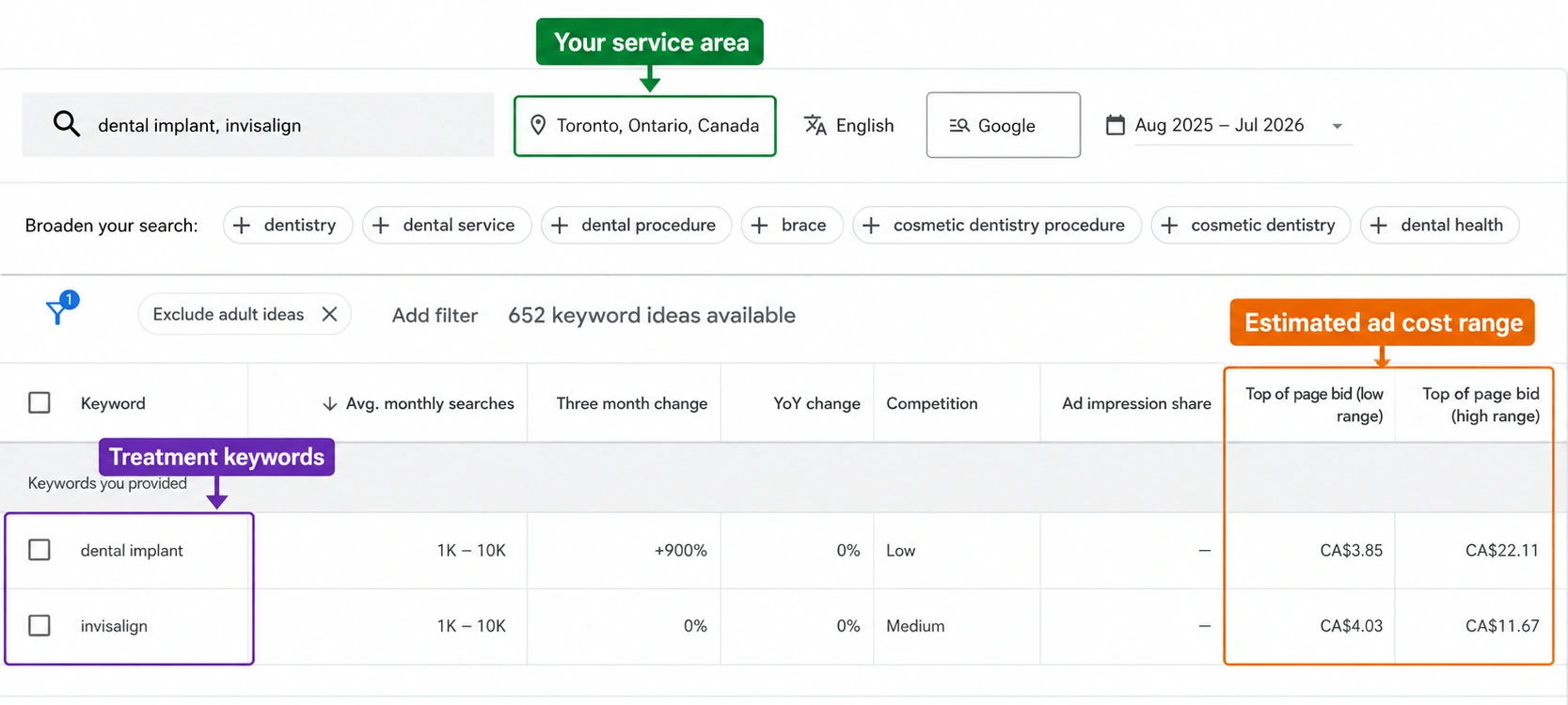
Do not use another dentist's national cost-per-click number as your target. Google's Keyword Planner lets you research search demand and estimated advertising costs for the location you actually serve.
If your practice operates in Toronto, research Toronto. If you operate in Dallas, research Dallas. Start with treatments you want to grow, then compare the local advertising environment with what an acquired patient is worth to your practice.
Use Keyword Planner
Choose “Discover new keywords” inside Google Ads.
Select the city or service area your practice actually serves.
Add services you want to grow, such as dental implants or Invisalign.
Compare searches, competition and Google's low and high top-of-page bid estimates.
Our dental PPC page explains how paid search fits into a broader dental patient acquisition strategy.
See What Patients See
Your competitors cannot show you their real ROI, but you can inspect some of the advertising patients see. Google and Meta provide public tools that make this useful without requiring paid competitor software.
Check Google Ads
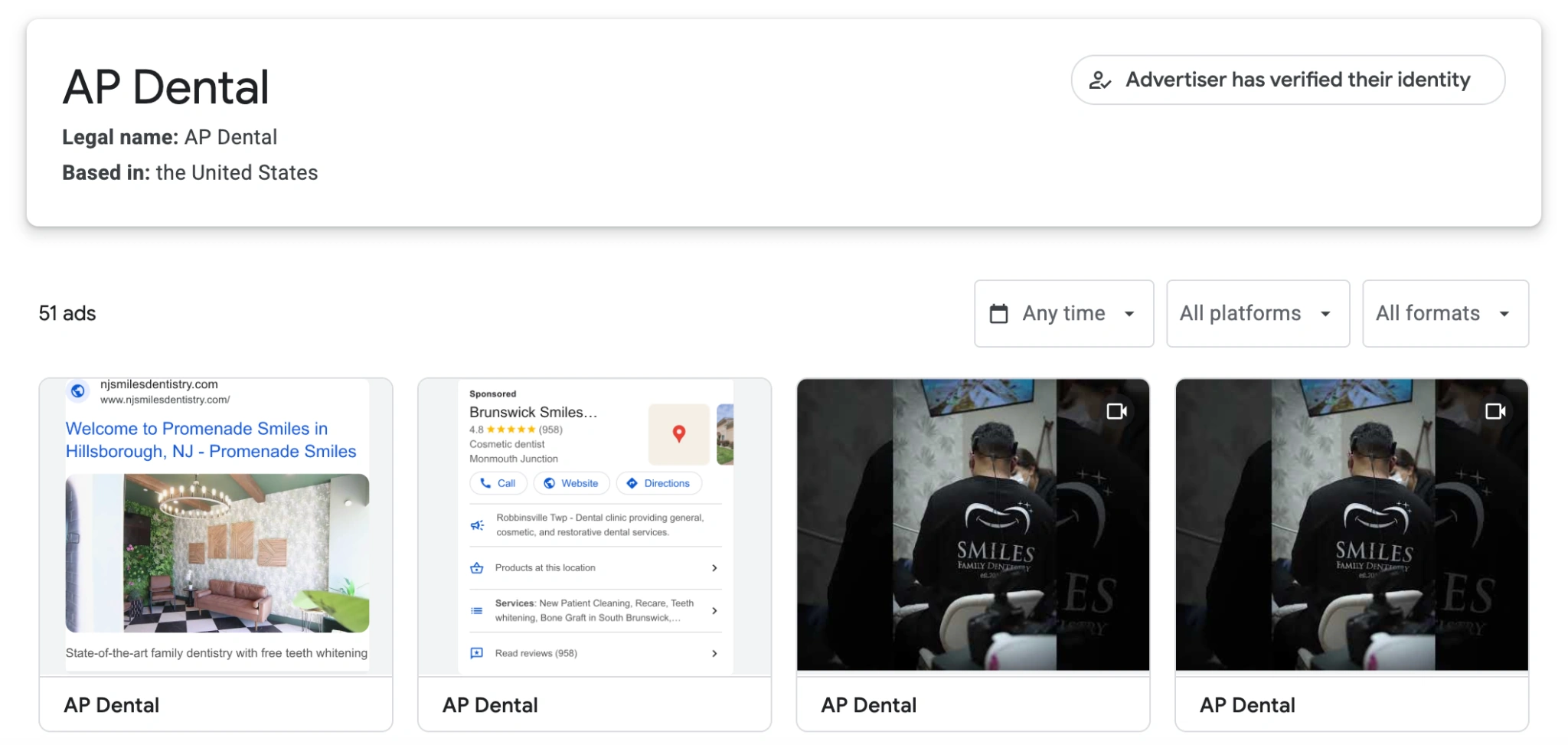
Google's ad archive lets you search advertisers and review creative available through the Google Ads Transparency Center.
Use Google Transparency
Go to Google's Ads Transparency Center.
Select the country where your practice competes.
Enter an advertiser name or website you already know.
Review treatments, offers, creative formats and calls to action.
Check Meta Ads
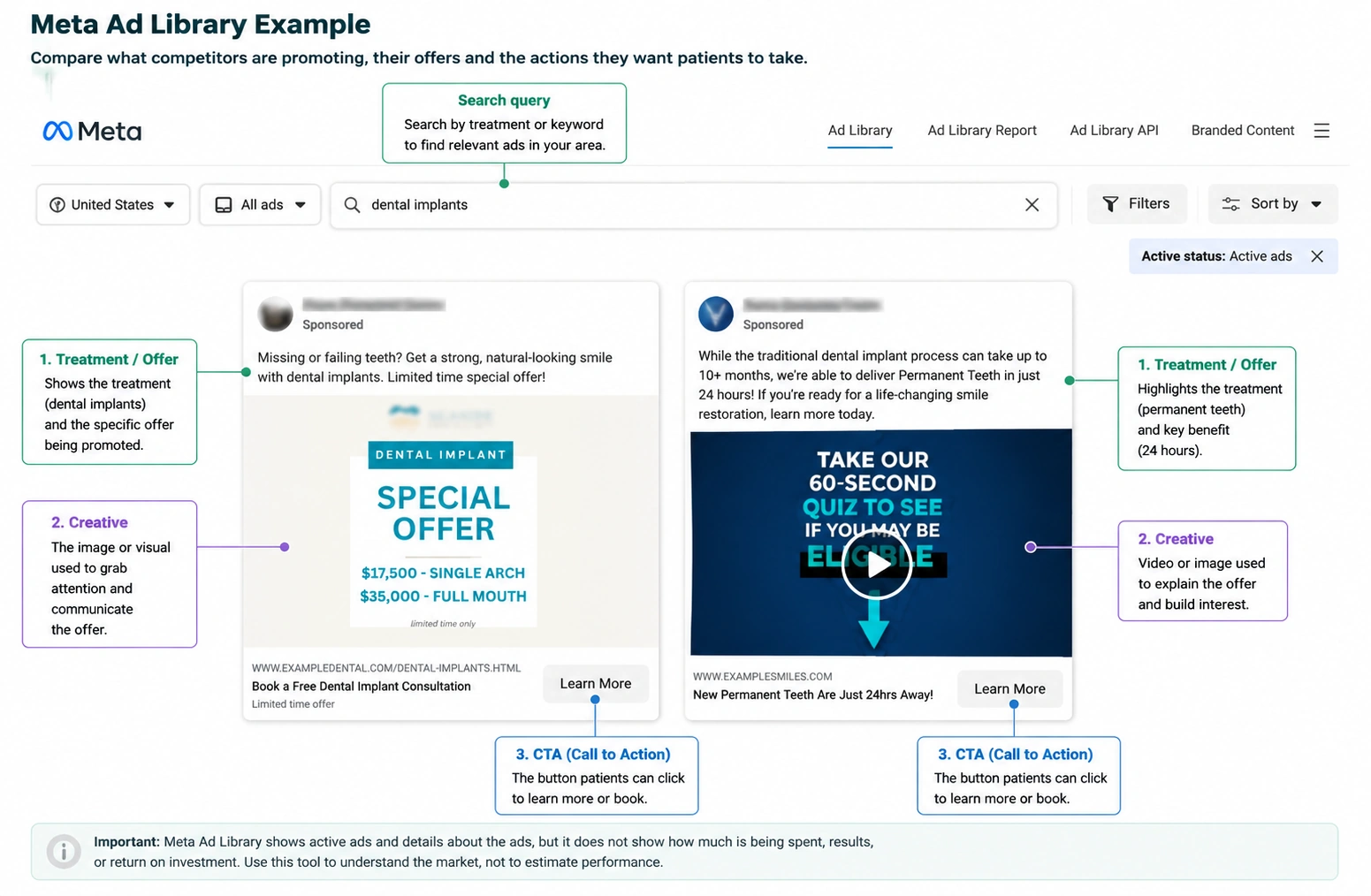
Meta's Meta Ad Library lets you inspect advertising running across Meta platforms. Search treatment terms or nearby practices to see the messages patients may encounter on Facebook and Instagram.
Use Meta Ad Library
Leads Can Still Fail
Sometimes the advertising works. A real patient sees the ad, contacts the practice and wants treatment. Something else can still prevent that person from reaching the chair.
Cost provides a clear example. Canadian research shows that affordability can interrupt the patient journey even when someone needs dental care.
Cost Barriers In Canada
Percentage of Canadians aged 12+ who reported avoiding oral health services because of cost.
How to read this chart: The 24% figure covers Canadians aged 12 and older overall. The 47% and 38% figures refer specifically to Canadians who met the eligibility criteria used in Statistics Canada's Canadian Dental Care Plan analysis.
Statistics Canada reported that 24% of Canadians aged 12 and older avoided visiting an oral-health professional because of cost during the previous 12 months.
A separate CDCP analysis found higher cost barriers among people who met the eligibility criteria used in the study. Nearly half, 47%, avoided an oral-health visit because of cost, while 38% avoided recommended dental care for the same reason.
Your Ads Can Leak
If leads come in but new-patient numbers stay flat, spending more on ads may simply send more people into the same broken process.
Start by finding the stage where prospective patients disappear.
Spot Lost Patients
Do Reminders Help?
A booked appointment does not generate patient revenue when the patient never arrives. Dental research gives practices a reason to pay attention to reminders.
Failed attendance among appointments studied before and after SMS reminders were introduced.
A dental SMS study involving two dentists reported failed attendance of 31% before SMS reminders and 14% after the practices introduced them.
A separate dental reminder study reported 14% lower odds of failing to attend after an SMS reminder system. The researchers also reported 15% higher odds of cancellation, so that context matters.
An orthodontic review found moderate-to-high quality evidence that reminders improved appointment adherence among orthodontic patients.
Automate The Right Steps
Automation works when you give it a specific job. Your practice might use it to acknowledge a missed call, respond to a web inquiry, remind a patient about an appointment or flag someone who needs appropriate follow-up.
A dentist describing a high-volume implant practice in an implant lead discussion mentioned dedicated administrative staff following up with marketing leads. Treat that as one practice owner's experience, not research or a performance benchmark.
If communication gaps appear in your patient journey, structured patient follow-up can help your team manage reminders and re-engagement more consistently.
Revenue Can Mislead You
Your dashboard may show impressive revenue from an advertising channel. Revenue still does not tell you how much money remained after the practice paid the costs connected with generating and delivering that care.
Dental Expenses Outpaced Revenue
Five-year change reported by the ADA Health Policy Institute for general dental practices.
How to read this chart: The bars compare the two reported growth rates with each other. The 4.9% expense increase is shown as the longest bar for comparison. It does not represent a 100% increase.
ADA practice economics report that general-practice revenues increased 1.4% while expenses increased 4.9% over a five-year period.
Decide which costs you want your ROI calculation to include. Depending on the question you are answering, those costs may include ad spend, management fees, tracking tools and other relevant expenses.
Know Patient Value
A new patient may create value beyond the first appointment, but that does not mean every dentist should use the same lifetime-value number.
Your practice already has better evidence: its own historical patient and collection records.
Use Your Own Data
| Patient Data | What It Tells You |
|---|---|
| First visit | Shows the immediate financial result from acquiring the patient. |
| Completed treatment | Shows care the patient actually received after the first visit. |
| Repeat visits | Shows whether the patient relationship continued. |
| Collected revenue | Keeps patient value tied to money the practice actually received. |
Discounts Need Better Math
A discount, coupon or limited-time offer can create appointments. A full schedule still does not prove the promotion made money.
Do not assume a discounted patient will become a poor long-term patient. Do not assume that person will become loyal either. Measure what your own promotion produces.
Stop Chasing DSO Budgets
A large dental group may appear constantly in search and social ads. That visibility does not tell you what your own practice should spend.
The ADA practice data show movement toward larger practices and DSO affiliation in the United States, especially among early-career dentists. The data do not establish a standard advertising budget for DSOs.
| Don't Compare | Measure Instead |
|---|---|
| Their monthly ad spend | Your patient acquisition cost |
| Their number of locations | Your available appointment capacity |
| Their lead volume | Your acquired patients |
| Their online visibility | Your collected patient revenue |
| Their campaign count | Your campaign profitability |
Ask a more useful question: What can our practice sustainably spend to acquire the next worthwhile patient?
Avoid These ROI Mistakes
Find Your Weak Spot
You do not need to label the entire advertising campaign a failure. Start with the stage where the numbers break down.
| What You Notice | Where To Investigate |
|---|---|
| Many clicks, few leads | Targeting, offer and landing page |
| Many leads, few bookings | Phone handling and response process |
| Many bookings, few shows | Confirmation and reminder process |
| Patients show, treatment stalls | Affordability, patient fit and treatment process |
| Treatment happens, ROI unclear | Source tracking and collections data |
Ask Better Questions
Your marketing report should help you understand what happens inside the practice, not only what happens inside an ad account.
Use this scorecard during your next marketing review.
Our breakdown of useful marketing reports explains why visibility metrics need to connect with meaningful patient actions.
Canadian Ads Need Care
Check Your Regulator
Advertising ROI does not matter if the promotion itself creates a compliance problem.
For Ontario practices, the RCDSO says dentists remain responsible for advertisements involving themselves and their clinics, including advertising that third parties create on their behalf.
Review the Ontario advertising rules before approving promotional claims, treatment offers or advertising messages.
What Good ROI Looks
There is no credible universal dental advertising percentage that every practice should treat as its definition of good ROI.
Your answer depends on patient acquisition cost, treatment mix, available capacity, collected revenue and the costs required to produce that revenue.
If you can answer those questions consistently, you can judge your own dental ads ROI without borrowing a benchmark from a completely different practice.
Check Your Own ROI
Stop at your own numbers. Enter your advertising spend, patient results and revenue into our free calculator to see what your campaign is actually returning.
ROI calculatorPull These Numbers First
You do not need a complicated analytics system to start. Pull the best information your practice already has from its advertising accounts, call or form tracking, practice management system and financial records.
| Number | Where To Find It | Why It Matters |
|---|---|---|
| Marketing spend | Ad accounts and invoices | Shows how much you spent to create demand. |
| Qualified leads | Call and form tracking | Shows how many realistic patient inquiries came in. |
| Bookings | Practice management system | Shows whether inquiries became appointments. |
| Shows | Practice management system | Shows whether booked patients reached the chair. |
| New patients | Practice management system | Shows actual patient acquisition. |
| Collected revenue | Billing and financial records | Connects patient acquisition with money received. |
| Relevant costs | Invoices and practice records | Helps you move from revenue reporting toward ROI. |
Dental Ads ROI FAQ
What Is Dental Ads ROI?
Dental ads ROI compares the return connected with advertising against the relevant costs included in your calculation. Keep the calculation consistent when comparing campaigns or reporting periods.
How Is ROAS Different?
ROAS compares attributed revenue with advertising spend. ROI asks a broader business question because it considers the relevant costs you include.
What ROI Is Good?
No universal ROI percentage works for every dental practice. Judge your results using your own patient acquisition cost, collected revenue, capacity, patient value and relevant costs.
Should I Track Leads?
Yes, but do not stop there. Track how many leads book appointments, show up, become new patients and generate collected revenue whenever your systems allow reliable tracking.
Can Reminders Help ROI?
Dental research shows that appointment reminders can improve attendance in some settings. Better attendance can help more booked patients reach the chair, but reminders do not guarantee a specific financial return.
Should I Copy DSOs?
No. Large groups may have different locations, staffing, treatment mixes and economics. Base your advertising decisions on your own patient acquisition economics.
Do Discounts Improve ROI?
Not automatically. Compare revenue with discounting, marketing costs, relevant delivery costs and later patient value before deciding whether a promotion worked.
