

What Does Your Tooth Number Mean?
You might be wondering: if people have the same types of teeth, why do dentists need different numbering systems?
Because tooth numbers are labels created for recordkeeping, not part of the anatomy itself.
Different countries and dental organizations developed their own ways of identifying the same teeth. Over time, those systems became built into dental education, charting, practice software, insurance records and everyday clinical communication, so more than one system continues to be used.
The United States most commonly uses the Universal/National Tooth Designation System, while Canada widely uses the FDI-derived two-digit system. Both describe the same mouth, but they assign different labels to the teeth.
That is why “tooth 16” can mean one tooth in one system and a completely different tooth in another. Before interpreting a number on a dental chart or treatment plan, first confirm which numbering system is being used.
Use our interactive chart to switch between Universal and FDI numbering and identify the matching tooth.
Are Tooth Numbers the Same in the US and Canada?
No. Dentists in the United States and Canada may use different tooth-designation systems.
United States
The Universal/National Tooth Designation System is the most commonly used system in American dentistry.
Permanent teeth use numbers 1 through 32. Primary teeth use letters A through T.
Canada
The two-digit notation originally devised by the FDI World Dental Federation is widely used in Canadian dentistry.
Permanent teeth use quadrant-and-position identifiers such as 11, 16, 26, 36 and 46.
How Can You Tell Which System Is Being Used?
You can often recognize the numbering system by looking at several tooth identifiers on the same chart or treatment plan.
Universal Clues
- Permanent teeth use single numbers from 1 to 32.
- Primary teeth use letters A through T.
- Numbers continue around the entire mouth rather than restarting by quadrant.
FDI / ISO Clues
- Permanent teeth use two-digit numbers.
- The first digit identifies the quadrant.
- The second digit identifies the tooth position from the midline.
- Examples include 11, 26, 36 and 48.
How to Read a Dental Chart
Dental charts are commonly displayed from the dental professional's viewing perspective.
Whenever you use a visual tooth chart, look for patient-right and patient-left orientation before matching a number to a tooth.
Universal vs FDI Tooth Numbers
The same anatomical tooth can have different identifiers under the two systems.
| Tooth | Universal | FDI / ISO |
|---|---|---|
| Upper-right central incisor | #8 | 11 |
| Upper-left central incisor | #9 | 21 |
| Upper-right canine | #6 | 13 |
| Upper-right first molar | #3 | 16 |
| Upper-left first molar | #14 | 26 |
| Lower-left first molar | #19 | 36 |
| Lower-right first molar | #30 | 46 |
| Lower-right central incisor | #25 | 41 |
| Lower-left central incisor | #24 | 31 |
How Universal Numbering Works
The Universal system assigns each permanent tooth a number from 1 through 32.
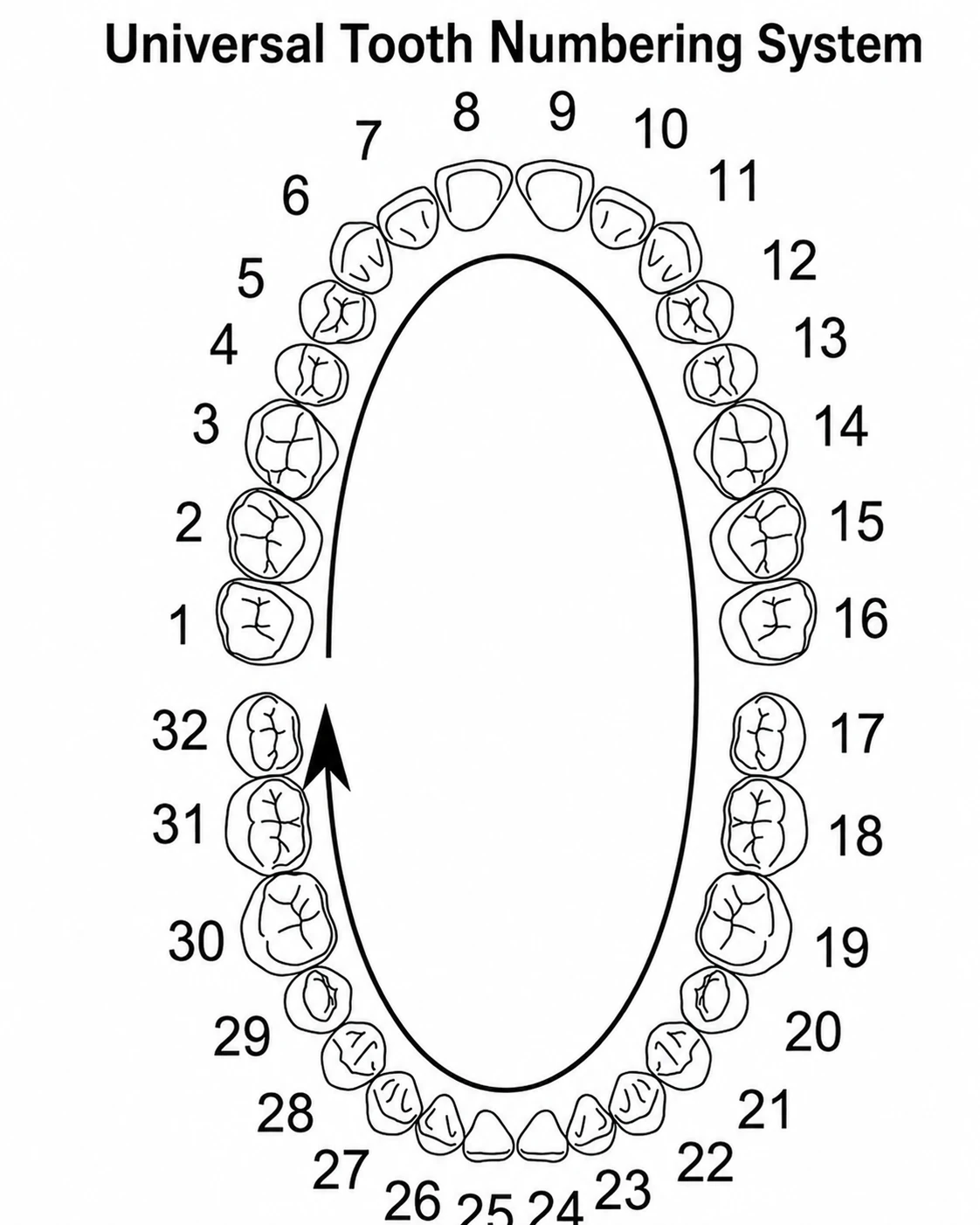
Universal permanent-tooth numbering starts at the patient's upper-right third molar and continues around the mouth to the lower-right third molar.
How to use this chart
- #1 is the upper-right third molar.
- #8 and #9 are the upper central incisors.
- #16 is the upper-left third molar.
- #17 begins the lower-left side.
- #32 finishes at the lower-right third molar.
Remember that the patient's right appears on the left side of the diagram.
Upper Teeth
Counting begins at the patient's upper-right third molar and continues across the arch to the upper-left third molar.
Lower Teeth
The sequence then continues from the patient's lower-left third molar across to the lower-right third molar.
How FDI Numbering Works
The FDI/ISO system uses two digits. The first identifies the quadrant, and the second identifies the tooth's position from the center of the mouth.
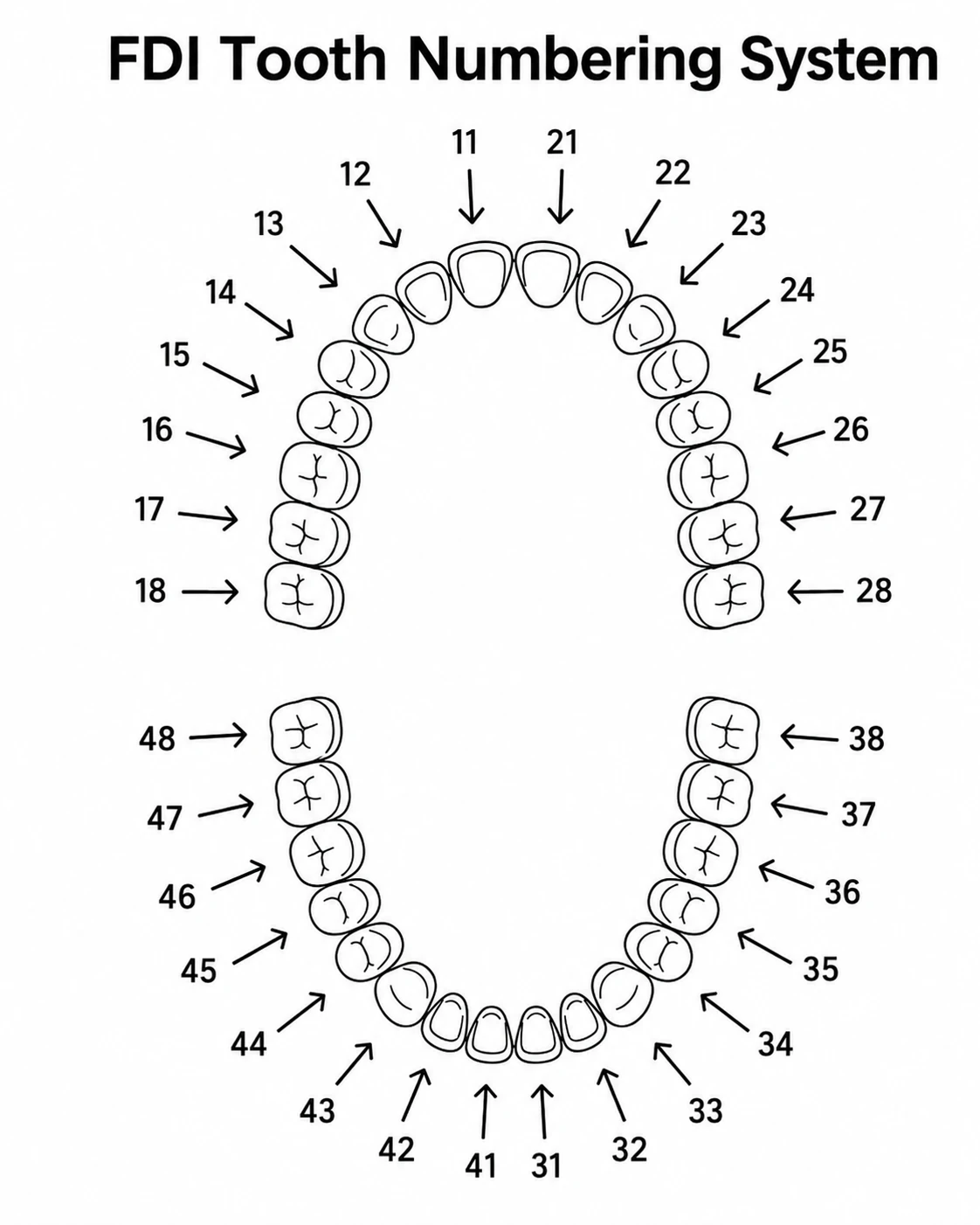
FDI permanent teeth use a two-digit identifier: the first digit tells you the quadrant and the second tells you the tooth position.
Read the two digits
- 11 is the upper-right central incisor.
- 16 is the upper-right first molar.
- 21 is the upper-left central incisor.
- 36 is the lower-left first molar.
- 46 is the lower-right first molar.
The number does not count continuously around the entire mouth. Each quadrant has its own sequence.
- 1 = upper right
- 2 = upper left
- 3 = lower left
- 4 = lower right
- 1 = central incisor
- 2 = lateral incisor
- 3 = canine
- 4 = first premolar
- 5 = second premolar
- 6 = first molar
- 7 = second molar
- 8 = third molar
Upper Teeth
Lower Teeth
What Does Tooth 16 Mean?
It depends on the numbering system.
Universal #16
The patient's upper-left third molar, commonly called the upper-left wisdom tooth.
FDI 16
The patient's upper-right first molar. The first digit identifies the upper-right quadrant, while the second digit identifies the first molar position.
How Baby Teeth Are Numbered
Primary teeth use a separate designation system because children normally have 20 primary teeth rather than the 32 permanent teeth possible in the adult dentition.
Universal Primary Teeth
The Universal system uses letters A through T.
The sequence starts with A at the upper-right second primary molar and continues around the mouth to T at the lower-right second primary molar.
FDI Primary Teeth
FDI uses quadrants 5 through 8 for primary teeth:
- 5 = upper right
- 6 = upper left
- 7 = lower left
- 8 = lower right
The second digit runs from 1 through 5.
Primary Tooth Examples
| Primary Tooth | Universal | FDI |
|---|---|---|
| Upper-right central incisor | E | 51 |
| Upper-left central incisor | F | 61 |
| Lower-left central incisor | O | 71 |
| Lower-right central incisor | P | 81 |
How to Read Your Treatment Plan
You do not need to memorize every tooth identifier to understand what your dentist is recommending.
Look for Universal, FDI/ISO or another notation method.
Use a reliable chart or converter to identify the anatomical tooth.
Read what treatment has been recommended for that specific tooth.
If anything is unclear, ask your dentist to point to the tooth in your mouth, on an X-ray or on the treatment plan.
For Dentists and Students
The Universal/National system and the FDI/ISO two-digit system are both established ways of identifying teeth.
The American Dental Association describes Universal as the most commonly used tooth-designation system in America. The Canadian Dental Association describes the FDI-derived two-digit system as the most widely used tooth-designation method in Canada.
Internationally, ISO 3950 defines the two-digit designation system for teeth and areas of the oral cavity.
What About Palmer Notation?
You may also encounter Palmer notation, particularly in orthodontic, pediatric or specialty settings. Palmer notation identifies a tooth by its position within a quadrant and uses quadrant symbols rather than the continuous Universal sequence or FDI two-digit code.
Reference Sources
This article prioritizes primary standards and professional dental organizations rather than relying on individual clinic blogs for tooth-numbering definitions.
If the Tooth Is Painful
A tooth number identifies location. It does not tell you how serious the dental problem is.
Know the System First
You do not need to memorize every tooth number. The important step is identifying which numbering system the chart uses before interpreting the number.
Once you know whether the document uses Universal, FDI/ISO or another notation method, the tooth location becomes much easier to decode.
What to Do Next
Explore local dental providers and treatment-specific listings through The Smile Insider's live dashboards.
Explore Dental DashboardsAdd your practice to The Smile Insider so patients searching local provider listings can discover your office.
Get Your Practice ListedTooth Number FAQ
What numbers are wisdom teeth?
In the Universal system, wisdom teeth are #1, #16, #17 and #32. In FDI notation, the permanent third molars are 18, 28, 38 and 48.
What tooth is number 8?
In the Universal system, tooth #8 is the patient's upper-right central incisor. In FDI notation, 8 by itself is not a complete permanent-tooth identifier because FDI uses two digits.
What tooth is number 16?
It depends on the numbering system. Universal #16 is the upper-left third molar or wisdom tooth. FDI 16 is the upper-right first molar.
What tooth is number 30?
In the Universal system, #30 is the patient's lower-right first molar.
What tooth is FDI 46?
FDI 46 is the patient's lower-right first molar. The first digit identifies the lower-right permanent quadrant, while the second digit identifies the first molar position.
Do tooth numbers change after an extraction?
No. Other teeth are not renumbered when a tooth is extracted. The original identifier remains associated with that tooth position in the dental record.
Why do baby teeth use letters?
In the Universal system, primary teeth use letters A through T so they can be distinguished from the permanent teeth numbered 1 through 32.
What numbering system is used in Canada?
The FDI-derived two-digit tooth-designation system is widely used in Canadian dentistry. However, always confirm the system shown on a particular dental record rather than assuming from location alone.
What numbering system is used in the United States?
The Universal/National Tooth Designation System is the most commonly used system in the United States.
Do orthodontists always use the same numbering system?
No. Depending on the specialty, country and clinical system, dental professionals may encounter Universal, FDI/ISO or Palmer notation. The notation system should be identified before interpreting the tooth reference.
